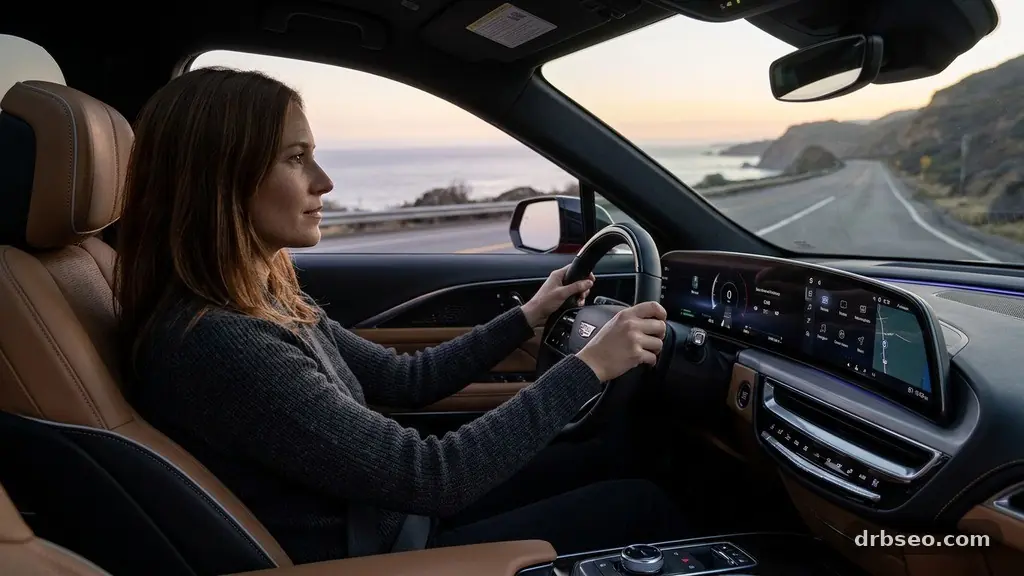
For anyone asking, “Do the Driving Modes in Cadillac LYRIQ Offer Different Ranges or Battery Usages? for 2026,” the short answer is no: the modes don’t create separate battery capacities or independently certified EPA ranges. Tour Mode, Sport Mode, Snow/Ice Mode, and My Mode change how the Cadillac LYRIQ responds, and those choices can influence real-world energy consumption.
That distinction matters because a sharper accelerator map, stronger climate demand, different traction behavior, or more frequent regenerative braking can change the miles shown on the display. The useful question isn’t whether one mode magically adds miles, but how each setting affects the way the Ultium battery’s stored energy is used.
The direct answer for 2026
Cadillac LYRIQ driving modes do not normally alter the size of the vehicle’s battery pack or give the SUV a separate EPA-estimated range for each setting. A LYRIQ with a particular drivetrain and battery configuration retains that configuration in Tour, Sport, Snow/Ice, and My Mode.
The EPA range figure is based on a defined test procedure and vehicle configuration, not on a promise that every mode will deliver the same number in every trip. Official ratings can differ by model year, wheel choice, drivetrain, software calibration, and trim, so a 2026 LYRIQ’s window sticker and owner documentation remain the right references for its certified figure.
In everyday driving, however, the mode can affect how quickly the battery’s usable energy is consumed. Sport Mode may encourage harder acceleration, while Snow/Ice Mode can soften throttle response and reduce wheel slip; the driver, road, weather, speed, heating, and air conditioning usually have a larger effect than the button itself.
Think of the modes as different control strategies rather than different fuel tanks. They adjust the relationship between your accelerator input, motor response, traction systems, steering feel, and sometimes regenerative behavior, but they don’t turn a standard LYRIQ battery into a larger or smaller one.
| Question | Practical answer |
|---|---|
| Does each mode have its own EPA range? | No. The EPA-estimated range applies to the tested vehicle configuration, not a separate range label for every drive mode. |
| Can a mode change miles per charge? | Yes, indirectly. Throttle response, traction control, speed, climate use, and regenerative behavior can alter real-world consumption. |
| Does Sport Mode increase battery capacity? | No. It changes the driving response and may use energy faster if it leads to stronger acceleration or higher speeds. |
| Is Snow/Ice Mode always more efficient? | No. It may promote smoother inputs, but cold temperatures, slippery roads, and winter climate use can reduce efficiency. |
That is the core verdict for 2026. The range difference you see between modes is an operating result, not a change to the LYRIQ’s underlying battery hardware.
What the LYRIQ driving modes actually change
The mode selector gives the driver a way to tailor the SUV’s behavior without changing its basic electric architecture. Tour Mode is the everyday default for many trips, Sport Mode provides a more immediate and energetic feel, Snow/Ice Mode is designed for low-traction conditions, and My Mode allows a more personal combination where the vehicle supports those adjustments.
These settings can influence the accelerator pedal’s response. If a small pedal movement produces a stronger motor reaction, the LYRIQ may accelerate more briskly, but the final energy use still depends on how far the driver presses the pedal and how long the vehicle stays at speed.
Drive modes may also alter steering effort and traction-control behavior. Those changes are noticeable to the driver, yet they don’t represent a second battery-management system with a separate energy reserve.
Tour Mode
Tour Mode is generally the sensible starting point for commuting, errands, and long-distance travel. Its balanced response makes it easier to apply power smoothly, which can help efficiency when the driver is trying to avoid sharp bursts of acceleration.
That doesn’t make Tour Mode an official “maximum range” setting. A careful driver in Sport Mode can use less energy than an impatient driver in Tour Mode, because speed, traffic, hills, and pedal technique matter more than the label on the screen.
Sport Mode
Sport Mode is intended to make the LYRIQ feel more responsive and engaging. A driver who repeatedly uses the stronger response, accelerates hard, or travels faster on open roads will usually see energy consumption rise.
Sport Mode itself doesn’t force the battery to discharge at a fixed excessive rate. If used briefly on a twisty road and followed by steady cruising, its effect on the entire trip may be modest.
Snow/Ice Mode
Snow/Ice Mode is aimed at improving control on slippery surfaces by making power delivery easier to manage. Smoother torque application can help prevent unnecessary wheelspin, which is useful for moving away from a snowy intersection or climbing a slick driveway.
Winter driving can still reduce range substantially even when Snow/Ice Mode is helping traction. Cold-soaked battery cells, cabin heating, lower tire pressure, slush, wind, and slower traffic all contribute to higher energy use.
My Mode
My Mode is the personalization option for drivers who want a preferred balance rather than a fixed factory personality. Depending on the specific vehicle and available settings, it can let the driver retain a comfortable response while selecting other preferred characteristics.
Because My Mode can be configured differently, its energy result isn’t a single number. Two drivers using “My Mode” may have different settings and driving habits, so the useful comparison is the actual consumption display over similar routes.
Battery capacity stays the same
The Cadillac LYRIQ uses the GM Ultium battery platform, with the vehicle’s usable energy determined by its battery configuration, drivetrain, software limits, and operating conditions. A drive-mode selection doesn’t add cells, remove cells, or change the advertised kWh battery pack into a different physical pack.
That point is easy to miss because the vehicle constantly manages energy in the background. The battery-management system may limit power or regenerative braking when the pack is very cold, very hot, nearly full, or close to empty, but those protections are not the same as a driver selecting Sport or Snow/Ice.
Battery capacity and battery usage are separate ideas. Capacity is the amount of energy the pack can store within its operating limits, while usage describes how quickly the vehicle spends that energy during a particular trip.
- Battery capacity: the stored-energy capability associated with the LYRIQ’s specific battery and vehicle configuration.
- Battery usage: the energy consumed by propulsion, climate control, electronics, and other systems during driving.
- Regeneration: energy recovered during deceleration and returned to the battery, subject to system and battery conditions.
- Displayed range: an estimate that changes as the vehicle learns from recent efficiency, temperature, terrain, and driving conditions.
A mode can affect the second and third items, and those changes can influence the fourth. It does not rewrite the first item.
The displayed state of charge also deserves attention. If the battery shows 70 percent in Tour Mode, it remains approximately 70 percent in Sport Mode; the difference is how far the vehicle may travel before reaching a lower charge level under the next set of conditions.
Why the range estimate can move
The LYRIQ’s predicted miles remaining is not a permanent measurement printed into the vehicle. It is an estimate informed by recent driving, temperature, speed, elevation changes, accessory loads, and other conditions that can vary from one journey to the next.
A driver may switch from Tour Mode to Sport Mode and see the predicted range fall after a period of brisk acceleration. That doesn’t necessarily mean the mode removed a fixed number of miles; the vehicle may be updating its forecast because recent consumption was higher than the history used before.
The opposite can happen too. A driver who selects Sport Mode but cruises gently at a steady speed may see little immediate difference, especially if the previous trip included hills, strong wind, or heavy climate use.
Speed is usually the bigger factor
Air resistance increases rapidly as road speed rises, so highway driving can consume much more energy than a slower suburban trip. If Sport Mode encourages a driver to travel faster, that speed effect can outweigh the direct calibration change associated with the mode.
This is why a controlled comparison must use the same road, weather, tire pressures, load, and speed. Comparing a Sport Mode highway journey with a Tour Mode city trip won’t reveal what the selector alone did.
Temperature changes the calculation
Cold weather affects an electric vehicle in several ways. The battery may need warming, the cabin heater requires energy, tire rolling resistance can increase, and winter roads may force slower yet less efficient progress through snow or slush.
Heat can also affect the LYRIQ, although the impact varies with ambient conditions and how the climate system is used. A comfortable cabin temperature, preconditioning while plugged in, and reasonable fan settings can help reduce the energy drawn during the first part of a trip.
Terrain and traffic matter
Climbing a long grade uses energy regardless of whether the LYRIQ is in Tour or Sport Mode. Regenerative braking can recover some energy on the descent, but it cannot return all the energy spent climbing because conversion losses are unavoidable.
Stop-and-go traffic is not automatically worse than highway driving in an EV, since the motor can recover some deceleration energy. Still, repeated hard launches, long idling with climate control, and congestion-related delays can reduce the benefit of regeneration.
Regenerative braking and one-pedal driving
Regenerative braking turns some of the vehicle’s kinetic energy into electrical energy as the LYRIQ slows. The recovered energy flows back to the battery instead of being lost entirely as heat through conventional friction brakes.
Regeneration is useful, but it isn’t free energy. The motor, inverter, battery, tires, and drivetrain each introduce losses, so the recovered amount will always be less than the energy previously used to accelerate the vehicle.
One-pedal driving can make deceleration feel more immediate when the driver lifts off the accelerator. It can be especially convenient in urban traffic, where frequent speed changes allow the driver to slow smoothly without moving constantly between accelerator and brake pedals.
Does stronger regeneration guarantee more range?
No. Stronger regeneration may recover more energy during a particular slowdown, but the overall result depends on why the vehicle had to slow in the first place. Accelerating hard and then braking heavily is generally less efficient than maintaining a steady speed and avoiding unnecessary speed changes.
A smooth driver using moderate regeneration can outperform an aggressive driver using the strongest available setting. The best efficiency pattern is usually anticipation: lift early, maintain space, and allow the vehicle to slow progressively.
When regeneration may be limited
Regenerative braking can be reduced when the battery is nearly full because there is less room to accept recovered energy. It may also be limited when the battery is cold or when traction conditions require careful control.
In those situations, the LYRIQ can rely more on friction braking or a different blend of braking systems. The driver may notice a different pedal feel, but that doesn’t indicate a new drive mode or a change in battery capacity.
Charging to a lower level before a steep descent may leave more room for regeneration, but drivers should follow the vehicle’s instructions and choose a charge level suitable for the planned trip. Safety and arriving with a reasonable reserve matter more than maximizing a small amount of recovered energy.
Rear-wheel drive and all-wheel drive differences
The drivetrain is a more important range variable than the mode selector. A rear-wheel drive LYRIQ and an all-wheel drive LYRIQ can have different EPA-estimated range ratings because the all-wheel-drive system adds motor hardware and weight, even though both vehicles use the same broad Ultium family of technology.
All-wheel drive can provide useful traction and stronger performance, particularly on wet, snowy, or loose surfaces. That capability can be valuable, but additional mass and motor operation may increase energy consumption under comparable conditions.
Drive modes don’t erase that drivetrain distinction. Sport Mode on a rear-wheel-drive model and Sport Mode on an all-wheel-drive model should not be assumed to deliver identical range because the vehicles may have different motors, wheels, tires, software, and certified ratings.
| Comparison factor | Why it matters for range | Can a drive mode change it? |
|---|---|---|
| Rear-wheel drive versus all-wheel drive | Motor count, mass, traction strategy, and hardware affect consumption. | No. The mode doesn’t convert one drivetrain into the other. |
| Wheel and tire package | Rolling resistance, tire width, and aerodynamic design can influence efficiency. | No. Select the vehicle configuration carefully before comparing ratings. |
| Battery temperature | Cold or hot conditions can limit power and regeneration while increasing auxiliary energy demand. | Not directly. The vehicle manages temperature automatically. |
| Acceleration style | Hard launches use more energy than smooth, progressive acceleration. | Indirectly. Some modes make sharper responses easier to access. |
When comparing 2026 models, use the range figure attached to the exact trim and drivetrain. The U.S. Department of Energy’s fuel-economy reference can also help verify published electric-vehicle ratings, while the vehicle’s own label remains the most specific source for its configuration.
How to compare modes fairly
A useful home test should resemble an experiment rather than a quick impression after pressing a button. Start with a similar state of charge, the same tire pressures, a comparable cabin temperature, and the same route in both modes.
Choose a loop long enough to smooth out a single hill or traffic light. A short one-mile comparison can be distorted by a brief acceleration, while a repeated route over several drives provides a more meaningful picture.
Record energy consumption in kWh per 100 miles if the vehicle displays it, or compare the change in state of charge over a known distance. Miles remaining is less reliable for a mode comparison because it is a forecast that may update during the trip.
A practical comparison routine
- Check tire pressure and remove unnecessary cargo.
- Begin with similar battery charge levels on comparable days.
- Use the same climate setting and avoid preconditioning only one vehicle run.
- Drive the same route at similar speeds in Tour Mode and the other selected mode.
- Repeat each run more than once before drawing a conclusion.
- Compare energy consumption, average speed, temperature, and traffic conditions together.
Don’t treat one dramatic result as proof. A headwind, rainstorm, cold start, or unusually aggressive acceleration can dominate the result and make the mode appear more influential than it really is.
For many owners, the most useful long-term test is simply observing the consumption screen over several weeks. If Sport Mode repeatedly coincides with harder launches and higher kWh use, the practical answer is clear for that driver, even if the mode’s underlying calibration is only part of the explanation.
Which mode should you use for maximum range?
Tour Mode is the easiest recommendation for an efficient everyday baseline because its balanced response supports smooth driving. Yet there is no universal “range mode” guarantee unless Cadillac specifically identifies one for the exact 2026 vehicle and software version.
My Mode may be a good choice for someone who wants a calmer accelerator response while retaining another preferred setting. The best configuration is the one that helps the driver avoid unnecessary acceleration and maintain a steady pace.
Snow/Ice Mode should be chosen for the conditions it was designed to address, not simply as an efficiency trick. If roads are slippery, controlled torque delivery and stable traction are more important than chasing a small theoretical consumption difference.
Sport Mode has a legitimate purpose, too. The LYRIQ is a premium electric SUV, and responsive performance can make the drive more enjoyable; using it occasionally doesn’t harm the battery, provided the vehicle is operated within normal conditions and charging guidance.
Simple habits that save more energy
- Keep highway speeds moderate and steady where safe and lawful.
- Use scheduled preconditioning while connected to charging when practical.
- Check tire pressures regularly, especially during seasonal temperature changes.
- Anticipate traffic so the vehicle can slow smoothly through regenerative braking.
- Carry only the cargo you need for the trip.
- Use cabin climate settings thoughtfully rather than relying on maximum heat or cooling.
- Choose Snow/Ice Mode for traction conditions, not as a substitute for winter tires or careful driving.
These habits affect real-world range more consistently than switching between two modes during a normal commute. They also make the energy display easier to interpret because fewer variables are changing at once.
Battery health and long-term ownership
Changing driving modes does not inherently damage the LYRIQ’s battery. The vehicle’s battery-management system is designed to control charging, temperature, power delivery, and protective limits across normal operating conditions.
Repeated high-power acceleration can raise energy use and may create more heat, but the vehicle manages that demand. The more immediate ownership effect is usually a shorter distance between charges, not a sudden loss of battery capacity.
Charging habits and temperature exposure are more relevant to long-term battery care than whether a driver occasionally selects Sport Mode. Follow Cadillac’s charging recommendations, avoid leaving the vehicle at an extreme state of charge for unnecessarily long periods, and pay attention to any messages shown by the vehicle.
Owners should also distinguish temporary range reduction from battery degradation. A cold morning may produce fewer predicted miles because operating conditions are unfavorable, while gradual capacity change over a long period is a different issue that requires consistent records to assess.
Why software updates matter
Electric vehicles depend heavily on software to coordinate motor output, thermal management, charging, and range prediction. A software update can refine the way the vehicle estimates range or manages energy without changing the physical battery pack.
If a 2026 LYRIQ behaves differently after an update, check the release information and owner’s documentation before assuming a drive mode has received a new range rating. The official vehicle information should take priority over casual comparisons posted by other owners.
Frequently asked questions
Does Sport Mode reduce the LYRIQ’s official range rating?
No. The EPA-estimated range is tied to the tested vehicle configuration, not a separate Sport Mode rating. Sport Mode can reduce real-world miles per charge if it leads to harder acceleration, faster driving, or more frequent speed changes.
Is Tour Mode the most efficient setting?
Tour Mode is usually the simplest baseline for efficient driving because its response is balanced, but it isn’t a guaranteed maximum-range mode. A smooth driver can achieve strong efficiency in another setting, while aggressive inputs can reduce range in Tour Mode.
Does Snow/Ice Mode use less battery?
Not automatically. It can make torque delivery gentler and help reduce wheelspin, but winter conditions often increase energy consumption through cold temperatures, cabin heating, snow resistance, and lower tire efficiency.
Can My Mode be set up for better range?
It may help if its settings encourage smooth accelerator use and comfortable, steady driving. My Mode doesn’t increase the battery’s capacity, and its actual efficiency depends on the selected configuration and the driver’s behavior.
Should I compare range estimates or energy consumption?
Energy consumption is usually the better measure because the remaining-range number is a moving prediction. Compare kWh use over the same route and conditions, then consider temperature, speed, traffic, payload, and climate settings before judging a mode.
What the answer means for 2026 owners
The answer to “Do the Driving Modes in Cadillac LYRIQ Offer Different Ranges or Battery Usages? for 2026” is clear: the modes don’t provide separate battery capacities or official range figures, but they can influence how efficiently the vehicle uses its stored energy. Tour Mode offers a balanced baseline, Sport Mode prioritizes response, Snow/Ice Mode supports slippery-road control, and My Mode adds personalization.
For the best result, compare the exact drivetrain and trim, watch kWh consumption rather than only predicted miles, and judge modes over similar routes. Select the setting that fits the road, drive smoothly, and let the LYRIQ’s energy display teach you what works best in your own climate and daily routine.