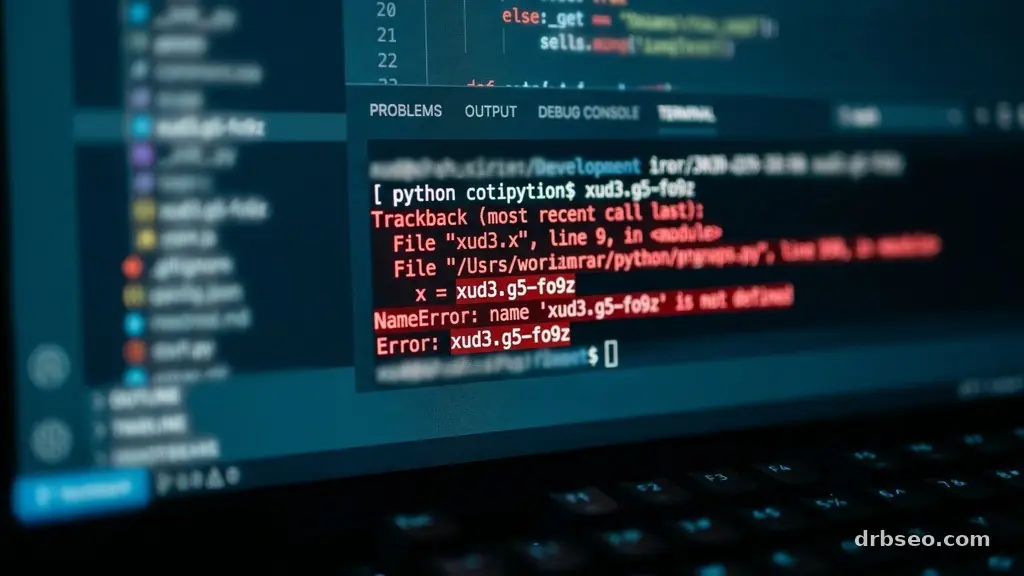
Fixing the xud3.g5-fo9z Python Error starts with one important fact: xud3.g5-fo9z is not a standard Python exception name documented by the Python interpreter. It is more likely a project-specific label, a corrupted dependency reference, an obfuscated message, or a fragment copied from a longer Python traceback. That distinction matters because reinstalling Python immediately may erase useful evidence without solving the real problem.
The practical approach is to capture the complete error, identify the failing file and line, isolate the environment, and then check imports, package versions, and application configuration. The steps below show how to diagnose the message safely, test likely causes, and confirm that the repair works rather than merely hiding the symptom.
Start With the Complete Error
The first step in fixing the xud3.g5-fo9z Python Error is to copy the entire terminal output, not just the unusual-looking text. A Python traceback usually includes the file path, line number, function call, exception type, and final message; the last line alone rarely explains the original failure.
Run the same command again and save the output if necessary. On macOS or Linux, a command such as python app.py 2> error.log writes error output to a file, while Windows PowerShell can use python app.py 2> error.log in the same way.
Read the traceback from the bottom upward. The final line often names the immediate exception, but the earlier lines show which call led to it. For example, ModuleNotFoundError points toward package installation or import paths, while SyntaxError directs attention to the reported source line.
- Record the exact command that produced the error.
- Copy the full Python traceback, including every “File” line.
- Note the Python version with
python --versionorpython3 --version. - Check the active interpreter with
where pythonon Windows orwhich pythonon macOS and Linux. - Write down the recent change, such as a package update, code edit, operating-system update, or new virtual environment.
Do not paste private API keys, database passwords, access tokens, or proprietary file contents into a public forum while seeking help. Replace those values with placeholders, but preserve the exception type, package names, paths, and line numbers.
What the Strange Code Usually Means
The text xud3.g5-fo9z does not match familiar built-in exceptions such as ValueError, TypeError, KeyError, or ImportError. Python exception classes normally use valid identifier-style names, so a name containing a dot and hyphen deserves closer inspection rather than an automatic assumption that the interpreter itself is broken.
Some applications display internal error codes that are generated outside Python. A web service, plugin, launcher, encrypted script, or monitoring system may attach a short identifier to a normal exception. In that case, searching the identifier alone may reveal little because the useful explanation remains in the hidden or omitted traceback.
Another possibility is that the string belongs to a package, configuration value, URL, filename, or command argument. A module import error might expose it if code tries to import a malformed module name, while a configuration parser could report it as an invalid key or endpoint.
Use basic text searches in the project directory to find where it appears. On macOS or Linux, grep -R "xud3.g5-fo9z" . searches recursively; in PowerShell, Get-ChildItem -Recurse | Select-String "xud3.g5-fo9z" provides a similar check.
If the search finds the string in your own source, inspect that line and its surrounding configuration. If it appears only in a generated log or external tool, identify the program producing the log before changing Python code. This simple distinction can save hours of debugging Python code in the wrong place.
Read the Python Traceback Correctly
A Python traceback is a call history, not a list of unrelated failures. Each frame shows a file and line that called the next function, so the bottom frame is usually closest to the immediate failure. The first frame may be your entry script, while the middle frames belong to libraries your code invoked.
Suppose the output ends with requests.exceptions.ConnectionError after several frames inside a client library. The problem may be a network address, certificate, proxy, or server response rather than a damaged installation. By contrast, File "config.py", line 18 followed by SyntaxError usually makes that source line the correct starting point.
Pay attention to the exception category and its message. A NameError means Python cannot resolve a variable or function name, an AttributeError means an object lacks the requested attribute, and a TypeError often indicates an operation received an unexpected kind of value.
| Traceback clue | Likely area to inspect | Useful first check |
|---|---|---|
ModuleNotFoundError |
Package installation or interpreter path | python -m pip show package-name |
ImportError |
Missing symbol or dependency conflict | Check package versions and import syntax |
SyntaxError |
Source formatting or Python version syntax | Open the reported file and line |
PermissionError |
File permissions, ownership, or protected folders | Check the target path and account permissions |
UnicodeDecodeError |
Text encoding mismatch | Identify the file encoding and read mode |
Python’s own official documentation on errors and exceptions explains how tracebacks, syntax errors, and runtime exceptions differ. Use that reference to verify the exception category before applying a fix designed for a different failure.
Confirm the Python Interpreter and Version
Many confusing errors come from running the right project with the wrong Python interpreter. A terminal may use Python 3.12, an IDE may use Python 3.10, and a scheduled task may invoke another installation entirely. Packages installed into one interpreter are invisible to another unless their environments are connected.
Check both the version and executable location. Use python --version and python -c "import sys; print(sys.executable)"; on systems where the command is named python3, run the equivalent with that command.
Windows users should also try py -0p, which lists registered Python installations. An IDE such as VS Code or PyCharm has its own interpreter selector, so compare the path shown there with the path printed by the terminal.
Python version compatibility matters when a project depends on compiled extensions or older libraries. A package may support Python 3.9 through 3.11 but fail to install or import correctly on Python 3.13, especially if no compatible wheel has been published.
Do not reinstall Python as the first response. Reinstalling Python can help when the executable or standard library is genuinely damaged, but it will not fix an incorrect import, an invalid configuration value, or a dependency conflict inside an otherwise healthy installation.
Build a Clean Virtual Environment
A virtual environment separates a project’s packages from global Python installations. Creating one is often the safest way to determine whether the error belongs to the application or to a cluttered environment containing incompatible versions.
From the project directory, create an environment with python -m venv .venv. Activate it on Windows with .venv\Scripts\activate, or on macOS and Linux with source .venv/bin/activate.
After activation, confirm the prompt changes and verify the interpreter path again. Then upgrade the packaging tools using python -m pip install --upgrade pip setuptools wheel; using python -m pip is safer than calling a standalone pip command because it ties pip to the active interpreter.
Install the project’s declared dependencies if a requirements.txt file exists. The command python -m pip install -r requirements.txt reproduces the environment described by that file, although an old requirements file may itself contain versions that no longer support your Python release.
Test the smallest possible import before launching the full application. For example, python -c "import package_name; print(package_name.__file__)" confirms which package Python loaded and can expose a shadowing file such as requests.py or json.py in the project directory.
Repair Packages and Dependency Conflicts
Package installation problems often look mysterious because the visible error comes from a downstream import. A dependency conflict occurs when one library requires a version range that clashes with another library, or when a package was installed for a different Python version or operating system.
Start by inspecting the environment with python -m pip list and python -m pip check. The second command reports installed distributions with unsatisfied requirements, which is more useful than repeatedly reinstalling whichever package appears in the last traceback line.
If one package is clearly damaged, reinstall that package inside the active virtual environment. Use python -m pip uninstall package-name, followed by python -m pip install package-name, but avoid removing several foundational packages at once because that makes it harder to identify the change that fixed or caused the problem.
Check the package’s supported Python versions before forcing an upgrade. A newer release may remove an import path used by older application code, while an older release may lack support for the interpreter you are running.
For a reproducible repair, record the working versions after testing. Commands such as python -m pip freeze > requirements.txt can capture the environment, but review the resulting file rather than committing every unrelated global package. A deliberately maintained requirements file is easier to reproduce than a snapshot containing accidental dependencies.
Check Imports, Files, and Configuration
A module import error does not always mean the module is absent. Python searches directories in a specific order, and a local file can hide a third-party package with the same name. Files named logging.py, email.py, random.py, or typing.py are common sources of confusing behavior.
Print the import location to confirm what Python is loading. For a package called example, run python -c "import example; print(example.__file__)". If the result points into your project when you expected site-packages, rename the conflicting local file and remove any stale __pycache__ directory if needed.
Configuration deserves the same attention as code. Environment variables, JSON files, YAML files, and command-line arguments can contain malformed values that later appear as strange identifiers such as xud3.g5-fo9z.
Print safe diagnostic information rather than secrets. You might log whether a variable exists, its length, or its selected mode, but never print a complete database URL, authorization header, private key, or token.
Also check the current working directory. A program launched from an IDE, terminal, and scheduled task may read three different relative paths, causing it to load different configuration files or fail to find a resource that exists elsewhere.
Use a Minimal Reproduction
Once the environment is stable, reduce the failing operation to the smallest script that still produces the message. A minimal reproduction might contain one import, one configuration value, and one function call instead of the application’s complete startup sequence.
This process separates the original defect from unrelated startup work. If the small script succeeds, the failure may involve application ordering, state left by an earlier operation, or a plugin loaded only by the full program.
Add temporary diagnostic output around the suspected boundary. Print the type of a value with type(value), show a non-sensitive representation with repr(value), and record which branch executes. These checks often reveal that a value expected to be a dictionary is actually None or a string.
Use exception handling narrowly while investigating. A block such as try and except Exception as exc can log the exception and then re-raise it, but a broad handler that silently returns will hide the original stack trace and make the xud3.g5-fo9z Python error harder to locate.
Do not “fix” the issue by deleting the traceback or catching every exception permanently. Once the cause is known, handle the specific exception that the program can reasonably recover from, such as a missing optional file, and allow programming errors to remain visible during development.
Use a Safe Recovery Sequence
If the source of the message is still unclear, use a controlled sequence rather than making random changes. First preserve the project, lock file, requirements.txt file, traceback, and current package list so you can reverse a change.
- Run the failing command again and save the full traceback.
- Identify the exact interpreter and active virtual environment.
- Search the project and configuration files for
xud3.g5-fo9z. - Run
python -m pip checkand inspect the relevant package versions. - Create a fresh virtual environment and install declared dependencies.
- Test the smallest import or function that reproduces the failure.
- Change one item at a time, then rerun the same test.
Changing one variable matters. If you upgrade three packages, alter the Python version, rename a file, and edit configuration in one session, you may get a working result without knowing why, which makes the next occurrence much harder to solve.
Back up before destructive actions such as deleting an environment or modifying production configuration. In a deployed service, reproduce the problem in a staging environment and preserve logs around the failure window before restarting workers.
If the message comes from a third-party launcher or hosted service, consult that product’s support documentation with the complete error code and timestamp. The application may own the identifier even though Python appears somewhere in the stack trace.
Prevent the Error From Returning
Good prevention begins with reproducibility. Keep the Python version, dependency file, startup command, and required environment variables documented in the repository, and avoid relying on packages installed globally on a developer’s machine.
Use a virtual environment for each application and activate it consistently. Continuous integration should create a fresh environment and install the declared dependencies, because that catches missing package declarations that a long-lived local environment can conceal.
Run basic checks before deployment. Syntax compilation with python -m compileall ., import smoke tests, and a small set of application tests can catch different classes of failure before users see an opaque identifier.
Pin versions when reproducibility matters, but review pins periodically. A completely unbounded dependency set can change unexpectedly, while pins that are never updated can leave security fixes and Python version compatibility improvements unavailable.
Improve error reporting without exposing secrets. Log the exception type, relevant module, application version, and correlation identifier, then keep credentials and personal data out of the record. A readable error message with a preserved stack trace is far more valuable than a short code that cannot be connected to the failing operation.
Finally, document the repair once confirmed. Note the incompatible version, renamed file, missing environment variable, or interpreter mismatch that caused the issue, along with the command that verified the fix.
Frequently Asked Questions
Is xud3.g5-fo9z a built-in Python exception?
No. The string does not resemble a standard built-in exception class, so it is probably an application-specific code, a dependency-generated identifier, malformed input, or an incomplete fragment of a larger message. The full traceback is needed to determine which explanation fits.
Should I reinstall Python immediately?
Usually not. First verify the interpreter path, Python version, active environment, package requirements, and traceback; reinstalling Python will not correct a bad import, incompatible package, or invalid configuration value.
How can I tell whether pip installed a package into the wrong environment?
Activate the intended virtual environment, run python -c "import sys; print(sys.executable)", and then use python -m pip show package-name. The executable and package location should both belong to the same environment.
What if the error appears only in an IDE?
Compare the IDE’s selected interpreter with the terminal interpreter and check the IDE’s working directory. Different interpreter paths or working directories can load different packages and configuration files even when the source code is identical.
Can I suppress the message with exception handling?
Only after identifying the exception and deciding that recovery is safe. Catching every exception can hide the original stack trace, leave the application in a partial state, and turn a diagnosable failure into a silent data or workflow problem.
Finish With Evidence, Not Guesswork
Fixing the xud3.g5-fo9z Python Error is less about recognising a magic code and more about recovering the evidence behind it. Capture the complete traceback, confirm the Python interpreter, isolate the virtual environment, inspect dependencies, and test the smallest reproducible case.
Once the program works, rerun the original command in the same environment and record the successful package and Python versions. That final verification turns a plausible repair into a repeatable one, and it gives you a clear starting point if the unusual message appears again.