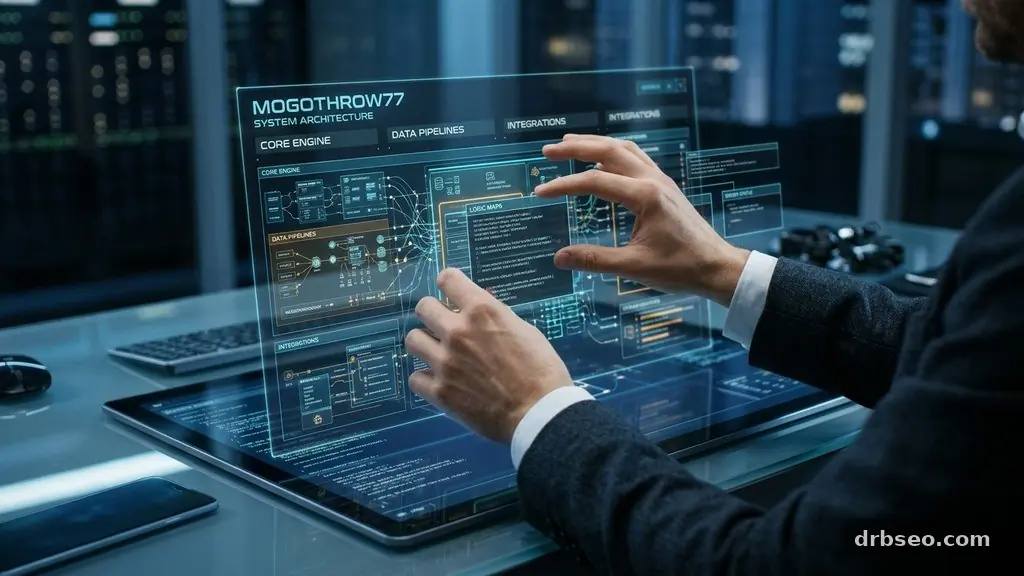
How Mogothrow77 Software Is Built is difficult to answer with certainty because Mogothrow77 does not appear to have a clearly documented, authoritative public repository or vendor architecture reference. That matters: claims about its framework, database, dependencies, or installation command should not be presented as fact without source code or signed documentation. The useful approach is to separate verified evidence from sensible engineering analysis, then inspect the package safely before running it.
This article explains what can responsibly be said about the software’s likely structure, how to evaluate its source code organisation, and how to prepare a controlled installation. It also shows which files and behaviours can reveal the frontend, backend, API, build system, runtime environment, and security posture without guessing.
What Is Known About Mogothrow77’s Build?
The direct answer is that there is not enough reliable public information to confirm Mogothrow77 software architecture, programming language, or official installation procedure. No responsible technical explanation should invent a framework name, repository owner, release date, database engine, or command simply to make the project sound more established than its evidence allows.
That uncertainty does not make investigation impossible. It means the first task is evidence collection: identify the original publisher, locate a source code repository or official release page, compare file hashes, read the included documentation, and determine whether the package is a source distribution, a compiled application, a script, or a container image.
A genuine project normally leaves several clues behind. A package.json may indicate a JavaScript package manager, pyproject.toml may point to Python tooling, go.mod identifies a Go module, and files such as Dockerfile, compose.yaml, or Makefile reveal parts of the build system.
Installation should wait until those clues have been checked. If a download arrives as an unexplained executable, asks for administrator privileges, disables security software, or connects to an unknown server before showing basic information, treat that behaviour as a warning rather than as a normal setup step.
The safest working conclusion is therefore conditional: Mogothrow77 may be analysable as a conventional modular application, but its actual architecture remains unverified until the publisher supplies inspectable source, release notes, or reproducible build instructions. That distinction protects readers from turning a plausible pattern into a false technical fact.
How to Read the Architecture Without Guessing
Architecture describes the way responsibilities are divided and how information moves between them. For Mogothrow77, the first question is whether it is a single desktop executable, a client-server application, a web application, a command-line utility, or a collection of scripts that happen to share a name.
A common arrangement has frontend and backend components. The frontend handles screens, forms, navigation, and local validation, while the backend applies business rules, authenticates users, stores records, and communicates with external services. That arrangement is only a hypothesis until the package contains browser assets, server routes, network configuration, or separate launch commands.
A second possibility is a monolithic application. In that model, the user interface, processing logic, and database calls live in one deployable program, often with fewer moving parts but tighter internal coupling. Small utilities frequently use this structure because a separate service would add operational complexity without solving a real problem.
The strongest architectural clues are usually visible in directory names and entry points. Folders called src, app, server, client, routes, controllers, services, and models suggest distinct responsibilities, though names alone cannot prove that the boundaries are well designed.
Network behaviour can add another layer of evidence. A local web interface may bind to a loopback address and expose an application programming interface (API), while a desktop program may contact a remote API directly. Reviewing documented endpoints, request formats, and authentication settings is safer than assuming that a port number or framework is present.
A useful analysis records confidence levels. “The archive contains a React build directory” is an observation; “the software uses React as its frontend” is a reasonable inference; “the backend is a Node.js service” requires stronger evidence such as a runtime manifest, server entry point, or launch script.
Source Code Organisation and Modular Design
Good source code organisation lets a maintainer find a feature without searching every file. A project might group code by technical layer, placing controllers, services, and database models in separate directories, or by feature, keeping authentication, reporting, and settings code together. Either approach can work when naming is consistent.
For an unverified package, inspect the top-level tree before opening files one by one. Look for a readme, licence, changelog, tests, examples, environment templates, and contribution notes. The absence of all documentation is not proof of malicious intent, but it makes installation and maintenance harder to assess.
Modular design matters because it limits the damage caused by change. If a reporting feature depends only on a defined service interface, a developer can replace its data source without rewriting the user interface. If every screen imports database functions directly, even a minor schema change can spread across the entire application.
Potential modules should have clear boundaries. An authentication module might validate credentials and issue sessions, a storage module might translate application objects into database records, and a notification module might handle email or messaging. These responsibilities should not be inferred solely from filenames; inspect imports, function calls, and configuration references to see whether the boundaries are real.
Tests provide especially valuable evidence. Unit tests may reveal expected inputs and outputs, integration tests can show how the API talks to the database layer, and end-to-end tests can document a user journey from login to completed action. A project with no tests is not automatically unsafe, but its behaviour is more difficult to verify before deployment.
Generated files deserve separate treatment. A large dist, build, or vendor directory may contain compiled output rather than the original source, and editing it can be pointless because the build process will overwrite it. The maintainable source usually lives elsewhere, with generated artefacts produced by a documented command.
Frontend, Backend, and API Boundaries
If Mogothrow77 includes a user interface, the frontend may be delivered as static HTML, JavaScript bundles, a native desktop view, or a server-rendered page. File extensions offer an initial clue, but the entry point and build manifest matter more than the presence of a few familiar assets.
Frontend code generally manages presentation state. It may request a list of records, submit a form, display errors, and store a short-lived session token, while the backend decides whether the request is allowed and whether the submitted data is valid. Client-side checks improve usability but should never be treated as the application’s security boundary.
The backend is where access control, business rules, and durable data handling should be enforced. Look for route definitions, middleware, service classes, validation schemas, and database queries. If sensitive decisions are made only in browser code, the design has a serious weakness because users can modify or bypass client-side logic.
An application programming interface (API) creates a contract between components. Useful documentation identifies endpoints, HTTP methods, required fields, response formats, authentication requirements, and error codes. Even an internal API benefits from predictable naming because it reduces confusion between the frontend and backend.
Inspect API configuration carefully. A base URL stored in a configuration file may point to a local development server, a production host, or an unexpected third-party endpoint. Never paste private keys, session tokens, or database passwords into public issue reports while investigating a package.
Cross-origin rules, rate limits, and input validation also reveal maturity. A server that accepts arbitrary origins, trusts user-supplied file paths, or returns stack traces to clients needs corrective work before exposure to the internet. These observations are more useful than attaching an impressive architectural label to a project whose controls have not been tested.
- Frontend evidence: views, browser bundles, routes, forms, and client-side state management.
- Backend evidence: server entry points, request handlers, middleware, business services, and validation logic.
- API evidence: endpoint definitions, schemas, authentication rules, and documented response formats.
- Boundary evidence: network calls, shared types, error contracts, and tests covering client-server interaction.
Dependencies, Build Tools, and Runtime Choices
Development tools leave a recognisable fingerprint. JavaScript projects often include a package manifest and lockfile, Python projects may use a project configuration file and virtual environment instructions, and compiled languages commonly include module metadata and a compiler-specific build definition.
The package manager is important because it determines how libraries are resolved and how repeatable installation can be. A lockfile records exact or constrained dependency versions, helping two machines install comparable trees. Without one, a fresh installation may silently receive newer packages that behave differently from the versions used by the author.
Dependency management should be examined before execution. Check direct dependencies, transitive packages, post-install scripts, native extensions, and references to private registries. A package that automatically runs arbitrary shell commands during installation deserves extra scrutiny, particularly if the source is unsigned or the publisher is unknown.
The build system explains how editable source becomes a runnable artefact. Scripts may compile TypeScript, bundle browser assets, generate database clients, copy templates, or embed version metadata. Read those scripts rather than running every available command, because names such as prepare, postinstall, and release can trigger actions beyond compilation.
The runtime environment must also be identified. A project may require a particular operating system, language version, database service, browser engine, or system library. These requirements should come from a manifest or official documentation, not from a random command copied from an unverified forum post.
Reproducibility is a strong sign of engineering discipline. A documented version range, locked dependencies, deterministic build command, and clean test run allow another person to compare results. If the project depends on a developer’s personal directory, undocumented environment variables, or a manually edited generated file, installation may fail even when the source itself is legitimate.
Configuration Files and the Database Layer
Configuration files connect an application to its environment. Common examples include .env.example, YAML files, JSON settings, command-line flags, and platform-specific service definitions. They may specify ports, log levels, database URLs, API endpoints, storage directories, feature switches, or encryption settings.
Never assume that a file named .env is safe to share. It may contain passwords, access tokens, signing keys, or cloud credentials. A safer project provides a redacted template with placeholder values and explains which settings are mandatory, which are optional, and which should be generated locally.
The database layer reveals how application data is persisted. Look for schema definitions, migrations, seed scripts, repository classes, query builders, and connection pooling. Migration files are particularly informative because they show how tables, indexes, relationships, and constraints have changed over time.
Installation should use a disposable database whenever possible. A new local database lets you test migrations and sample data without risking production records. If a setup script drops tables, modifies an existing schema without confirmation, or requests a powerful database account, stop and review the command before continuing.
Data protection extends beyond passwords. Logs can expose email addresses, access tokens, uploaded filenames, or full request bodies, while backups can retain deleted information indefinitely. Check whether sensitive fields are encrypted where appropriate, whether credentials are hashed rather than stored in plain text, and whether error messages reveal internal paths.
Configuration and data should remain separate from source control. Version control with Git can track a safe template and migration history, but it should not contain live secrets. If a secret has ever been committed, deleting the visible line is not enough; the repository history may still preserve it and the credential may need to be revoked.
Version Control, Repository Evidence, and Documentation
A trustworthy source code repository gives readers more than a download button. It should identify the project owner, show a coherent commit history, explain supported versions, describe known limitations, and provide a repeatable way to build and test the software.
Version control with Git can show how the project developed. A sudden repository reset, a large unexplained binary, or a release that differs sharply from the visible source deserves investigation. Conversely, clear commits, tagged releases, reviewed changes, and issue discussions make it easier to understand why a dependency or configuration setting exists.
Documentation should answer practical questions. What does the software do, which platforms are supported, where is user data stored, how is an update performed, and how can a failed installation be reversed? Documentation that explains only how to start the program but says nothing about permissions, network access, or data removal is incomplete.
This is also where documenting and explaining the project becomes part of the engineering work rather than an afterthought. A short architecture note can identify the entry point, major modules, data flow, external services, and trust boundaries without exposing private credentials or operational secrets.
Release integrity matters when binaries are distributed. A publisher may provide checksums, signatures, or a reproducible build process that lets users confirm the file they downloaded matches the intended release. If a file comes from a reposting site and has no provenance, the reader cannot confidently connect it to the claimed source.
External standards can help investigators interpret these signals. The official Git documentation explains repositories, commits, branches, and other concepts needed to inspect a project’s history without relying on an unverified tutorial.
| Evidence | What it can show | What it cannot prove alone |
|---|---|---|
| Repository history | Development activity, release changes, and authorship clues | That every published binary matches the visible source |
| Lockfile | Resolved dependency versions for a particular package manager | That dependencies are secure or free from malicious code |
| Architecture diagram | Intended component boundaries and data flow | That the implementation still follows the diagram |
| Checksum or signature | Integrity or publisher verification, depending on the method | That the software itself is safe to run |
A Safer Installation Workflow
Because Mogothrow77’s official installation instructions are not established here, use a verification-first workflow rather than a guessed command. Start by recording the download address, publisher identity, file name, size, checksum if supplied, and the date you obtained it.
Next, inspect the archive without executing its contents. List files, read the readme, identify scripts and binaries, and check whether the package contains unexpected items such as credential stores, browser extensions, scheduled-task definitions, or obfuscated code. A source archive should not need to conceal its entry point.
Use an isolated environment for the first run. A virtual machine, disposable user account, container with restricted permissions, or separate test computer can limit access to personal documents and credentials. Network access should be blocked initially unless the documented function clearly requires it.
Install only from verified instructions and use the project’s declared toolchain. If the package requires a package manager, confirm the package name and repository before resolving dependencies. Avoid commands that pipe remote content directly into a shell, especially when the origin is not an official publisher.
Before launching the application, create a clean configuration from a template. Use dummy credentials, a non-production database, and a temporary storage directory. Keep a record of every command because that makes troubleshooting and rollback far easier than relying on memory.
After launch, observe rather than trust. Check listening ports, outbound connections, created files, child processes, and log output. The application should behave consistently with its stated purpose; a simple local utility that immediately contacts several unrelated domains has a mismatch worth investigating.
Do not grant administrator rights merely because an installer requests them. Ask what system change requires that access, whether a user-level installation is possible, and whether the publisher documents the requirement. A failed setup is inconvenient; an uncontrolled installation can expose an entire machine.
Testing, Maintenance, and Troubleshooting
Testing should begin with a clean, repeatable baseline. Record the operating system, runtime version, package-manager version, dependency lockfile state, and database version. Those details turn an unclear failure into a reproducible technical report.
Common installation errors have different causes. A missing command may indicate that the runtime is not installed or is outside the expected path, while a compilation failure may indicate an incompatible native library. A database connection error usually points to a service, port, credential, migration, or configuration problem rather than to the frontend.
Read the first meaningful error, not merely the final line. Build tools often print a cascade of secondary failures after one missing dependency or malformed configuration value. Copying the full log into a public forum can disclose usernames, absolute paths, tokens, or internal hostnames, so redact sensitive material first.
Once the application starts, test its smallest useful workflow. Create a dummy record, restart the service, confirm that the record persists, and remove it. This checks the basic path through the frontend, API, business logic, database layer, and storage configuration without introducing real data.
Updates need the same care as the first installation. Review release notes, back up the test database, inspect migration scripts, and confirm that dependencies changed as expected. A new version may alter configuration names, database schemas, API behaviour, or required runtime versions even when the user interface appears unchanged.
A maintenance plan should identify who owns the repository, how vulnerabilities are reported, how backups are restored, and when old versions stop receiving fixes. If those answers are unavailable, keep the software isolated and avoid placing confidential information inside it.
Questions Readers Commonly Ask
Is Mogothrow77 open source?
That cannot be confirmed from a clear, authoritative public source currently available for this analysis. Treat it as open source only if the publisher provides inspectable source code under a recognisable licence and the released package can be connected to that source.
Which programming language does Mogothrow77 use?
No language should be stated as fact without a repository, manifest, readable source, or reliable vendor documentation. File extensions and dependency files can provide clues, but a compiled binary alone may not identify the original language accurately.
Can I install it directly on my main computer?
That is not the safest first step while the publisher and installation method remain uncertain. Inspect the package in an isolated environment, use non-sensitive test data, restrict network access, and grant only the permissions the documented function genuinely requires.
What files should I inspect first?
Begin with the readme, licence, changelog, package manifest, lockfile, configuration template, build scripts, and database migrations. Then identify the main entry point and review any post-install or startup scripts before executing them.
How can I verify that a download is genuine?
Prefer an official publisher-controlled release channel, compare the file checksum or signature when provided, and match the binary to a tagged source release where possible. A checksum copied from the same untrusted page is weaker evidence than a signature or independently maintained release record.
Practical Takeaways
How Mogothrow77 Software Is Built cannot be described accurately through invented framework names or assumed installation commands. The defensible method is to inspect source code organisation, dependency manifests, configuration files, API boundaries, database migrations, build scripts, and Git history, while clearly separating observation from inference.
Before installing, verify provenance, isolate the first run, use dummy data, and watch the software’s network and file activity. If you locate an official repository or release document, compare its evidence against these checks and share the specific artefacts that support your conclusions; that is the fastest way to turn an uncertain package into a technically grounded assessment.