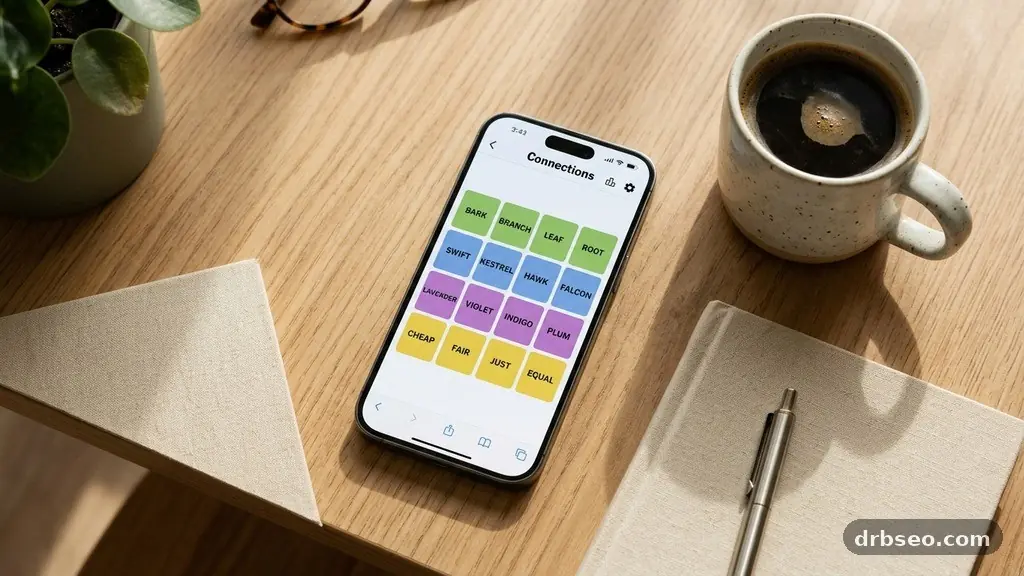
Connections NYT puzzles are dated carefully, and “Mon, Nov 16” needs a year before any reliable hint can be given. The date Monday, November 16 falls in 2026; November 16, 2025 was a Sunday, so the wording most likely points to the 2026 edition.
That puzzle has not been published yet, which means specific clues or a puzzle solution would be guesswork rather than useful help. The good news is that you can still prepare for the four-colour grid, understand how NYT Connections works, and use spoiler-free tactics that make the eventual daily word puzzle easier to read without giving away answers.
The answer about Monday, November 16
The clearest answer is this: there is no verified Connections puzzle for Monday, November 16, 2026 yet. The New York Times releases one new puzzle each day, so a future edition cannot have confirmed yellow, green, blue, or purple groups before publication.
Date confusion is common because many puzzle pages omit the year in their headlines. If a result says “Mon, Nov 16” without identifying the year, check the calendar and the puzzle archive before trusting its hints. A Monday date in one year may become a Sunday, Tuesday, or another weekday in the next.
For reference, the relevant calendar dates are easy to separate:
| Date | Day of the week | What it means |
|---|---|---|
| November 16, 2025 | Sunday | Not a Monday Connections edition |
| November 16, 2026 | Monday | The likely date named by the search phrase |
| November 16, 2027 | Tuesday | Another weekday mismatch |
That distinction matters because an invented clue can send you toward the wrong category and spoil the solving experience. Until the 2026 board appears, the responsible answer is to explain the solving structure and offer methods that will help once the grid is live.
How the NYT Connections board works
NYT Connections presents 16 words or short phrases in a four-by-four arrangement. The goal is to divide every entry into four groups of four, with each group linked by a shared idea.
The connection might be direct, such as four animals, or more slippery, such as words that can follow a particular verb. A group can involve names, abbreviations, brands, sounds, meanings, spellings, or cultural references. The board rewards flexible thinking rather than a single vocabulary skill.
Each solved category is marked with a colour. The yellow category is generally the most approachable, while the green category often requires a little more thought. Blue and purple commonly contain more specialized, playful, or linguistically indirect connections, although the colours indicate difficulty rather than a fixed subject.
The four-colour system is useful because it gives the player a rough route through the board. You don’t need to identify all sixteen words at once; finding one secure group reduces the number of possible relationships among the remaining entries.
The game allows only a limited number of mistakes, so random selection is expensive. A promising set should have a clear rule that applies to all four words, not merely a theme that two or three entries appear to share.
Why a future puzzle cannot have real hints
Hints only become meaningful after the actual board is available. Before release, there is no reliable way to know whether a phrase belongs to the yellow category, serves as a decoy, or is part of a wordplay-based purple group.
That limitation is especially important with a word-association game. A clue such as “things found in a kitchen” sounds useful, but it could point toward tools, appliances, verbs, colours, or words that precede “pan.” Without seeing the sixteen entries, the hint has no stable target.
Search results can also mix separate editions. A page published for one November 16 may be recirculated in another year, while social posts may discuss a puzzle according to a local time zone. The headline alone isn’t enough evidence.
For a trustworthy check, open the official New York Times Games page and confirm the displayed date against the board you have in front of you. That simple step prevents a common mistake: reading a correct hint for the wrong day.
Once the puzzle is published, useful hints should describe the category without revealing all four words. They might identify a grammatical pattern, a broad subject, or the kind of relationship involved. A full puzzle solution is different because it removes the central discovery.
Reading the four colour categories
Colour labels help describe the board, but they shouldn’t be treated as guarantees. Yellow is often the first group a player can see, yet an apparently obvious set may be a deliberate trap designed to overlap with a stronger category.
Yellow and green
The yellow category usually relies on a familiar connection. Four words might be types of a common object, names associated with one field, or terms that share a straightforward definition.
Green tends to demand a second look. Its entries may be connected by a phrase, a use, or a narrower classification that isn’t immediately visible from the words alone.
Blue and purple
Blue often draws on a particular area of knowledge, such as entertainment, geography, sport, food, or technology. You don’t need specialist expertise for every puzzle, but you may need to recognise the intended context rather than the most common meaning of each word.
Purple is frequently the most playful category. It may involve spelling changes, prefixes, suffixes, homophones, missing words in titles, or a repeated word that can pair with each entry. If three words seem to fit perfectly, inspect the fourth for a less literal connection before committing.
The colours are best used as a loose solving sequence: search for a clean yellow group, reconsider the leftovers, then test the more technical or wordplay-heavy relationships. No rule says you must solve them in colour order.
A practical method for solving the live grid
When the future November 16 board eventually appears, start by reading every entry once without selecting anything. First impressions matter, but they can also create tunnel vision; a word that looks like a noun may function as a verb, name, abbreviation, or part of a familiar phrase.
Next, mark possible relationships mentally. Don’t build a final group from one striking connection. Instead, look for four entries that follow the same rule with similar strength.
- Scan for obvious sets: notice clear collections such as months, dog breeds, card suits, or cooking methods.
- Test phrase patterns: ask whether one word can come before or after each candidate.
- Check multiple meanings: a word may be a person, an action, an object, or a brand name.
- Watch for decoys: two words that share a topic do not prove that the complete group is correct.
- Use a tentative group: select only when the fourth member fits the same rule rather than merely belonging to the same broad subject.
- Reassess leftovers: after one group disappears, reread the remaining twelve as a fresh puzzle.
If you’re unsure, write the candidate groups on paper or in a notes app. Externalising the words reduces the pressure of the grid and makes recurring structures easier to spot.
Try to state the category in a short sentence before submitting. “Words that can follow ‘coffee’” is testable; “things connected to drinks” is too vague. The more precise explanation usually exposes a weak candidate.
How to use spoiler-free hints well
A good hint should restore your direction without doing the final act of grouping for you. For example, “three entries relate to a type of performance, while the fourth has a less obvious professional meaning” is more useful than listing the four answers.
Hints work best in stages. Begin with a broad nudge about the category type, then request a narrower clue only if the first does not help. This preserves the satisfying part of the solve while preventing a long, frustrating stall.
For the November 16 search phrase, the only honest pre-publication hint is procedural: confirm the year, wait for the board, and avoid pages that present uncited answers to a puzzle that does not yet exist. A supposed clue before release is likely recycled, speculative, or tied to a different calendar year.
After publication, compare a hint with your own observations. If the clue suggests “words associated with a musical setting,” check whether all four entries fit that setting in the same way. Don’t force a word into the category simply because a hint sounds close.
It also helps to stop reading once you’ve received enough assistance. If a yellow-category clue gets you moving, close the page and return to the grid. The purpose of spoiler-free help is to support your reasoning, not replace it.
Common traps in the Connections puzzle
The most familiar trap is an apparent category containing five possible words. Because only four entries can belong together, the extra word is often the key to distinguishing a surface-level theme from the intended group.
Another trap involves broad topics. Four entries may all relate to food, travel, or music, but that doesn’t make them a valid category. Connections usually wants a sharper relationship, such as words that precede a specific dish, names of one musical role, or terms used by a particular profession.
Parts of speech can mislead solvers too. Four words may look like objects, but the intended link might be that each can follow “run,” “light,” or “house.” Say the possible phrase aloud; sound often reveals a connection that spelling hides.
Proper names deserve special care. A word that resembles a person’s name may also be a place, a product, a fictional character, or a common verb. The puzzle can exploit that ambiguity without making the entry unfair.
Finally, don’t assume the hardest-looking group is purple. A rare term may be part of an ordinary category, while a familiar word can become difficult because it participates in an unusual phrase. Difficulty comes from the relationship, not just the vocabulary.
What to do after one group is solved
Solving one group changes the board’s logic. Remove the four entries mentally and inspect the twelve remaining words without relying too heavily on your first interpretation. A word that seemed connected to the solved group may now reveal its intended role elsewhere.
Keep track of why the group worked. If the explanation was “these are all types of X,” ask whether the remaining words contain a parallel set. If it was “these can follow Y,” search for another shared word or phrase structure.
The reduced board also makes decoys easier to identify. An attractive three-word pattern may collapse when only one possible fourth entry remains, signalling that the first idea was too broad.
When two groups compete, compare their precision. A valid category generally has a clean definition that applies evenly to all four words. The weaker group often depends on one loose association, a different grammatical rule, or a special exception.
Don’t be afraid to undo a theory before making a submission. In Connections, changing your mind is part of the process, not evidence that you played badly. The board is designed to make plausible wrong paths feel tempting.
Keeping track of dates and puzzle archives
Daily games create a deceptively complicated archive. A headline may use a short date, while the page metadata, local publication time, or answer key uses a different format. That is why the year matters for any request involving “Mon, Nov 16.”
Time zones can add another layer of confusion. A puzzle released late in the evening in one region may appear under the next calendar date elsewhere, especially when social posts and screenshots are shared internationally.
Before using a reported solution, compare three details: the weekday, the month and day, and at least one visible board entry. If any of those conflict, you’re probably looking at a different edition.
A simple personal archive can help. Record the date, your completion result, and the category themes without copying the entire answer set. Over time, this shows whether certain traps—proper names, phrase completions, or overlapping subjects—cause repeated trouble.
For the specific phrase “Connections NYT: Hints For Today’s Puzzle, Mon, Nov 16,” the archive check is decisive. The matching Monday is in 2026, and until that date arrives, no authentic daily answer or category list can be confirmed.
FAQ about the November 16 puzzle
Which year does Monday, November 16 refer to?
The Monday date is November 16, 2026. November 16, 2025 fell on a Sunday, so a headline that explicitly says “Mon, Nov 16” most naturally points to 2026.
Are there confirmed hints for the 2026 Connections puzzle?
Not before the puzzle is published. Any specific category or answer presented in advance would be speculation unless it came from an official release or a verified board after publication.
How many words are in an NYT Connections game?
Each board contains 16 entries. Players divide them into four categories of four, with every entry used exactly once.
What do the yellow, green, blue, and purple categories mean?
They identify the four groups and generally suggest increasing difficulty, from yellow toward purple. The colour order is a helpful convention, not a guarantee that every puzzle follows the same level of challenge.
What is the best first move on a difficult board?
Read all sixteen entries, search for one precise relationship, and test possible decoys before submitting. A strong category explains all four words with the same rule and does not depend on a loose shared topic.
Making the next solve more enjoyable
The strongest way to approach a future NYT Connections board is with curiosity rather than speed. Give each word several possible roles, and allow the category to emerge from the relationship between entries instead of forcing the first theme you notice.
For Monday, November 16, the practical next step is simple: verify the year and return when the 2026 grid is available. Once the board is live, spoiler-free hints can point toward the yellow, green, blue, or purple group without taking away the pleasure of finding the final link yourself.
Until then, treat confident-looking answers with caution. Connections NYT is at its best when the words, not an invented preview, lead the solve.